
Helsinki old map
You can find on this page the Helsinki old map to print and to download in PDF. The Helsinki historical map and the vintage map of Helsinki present the past and evolutions of the city of Helsinki in Uusimaa - Finland.
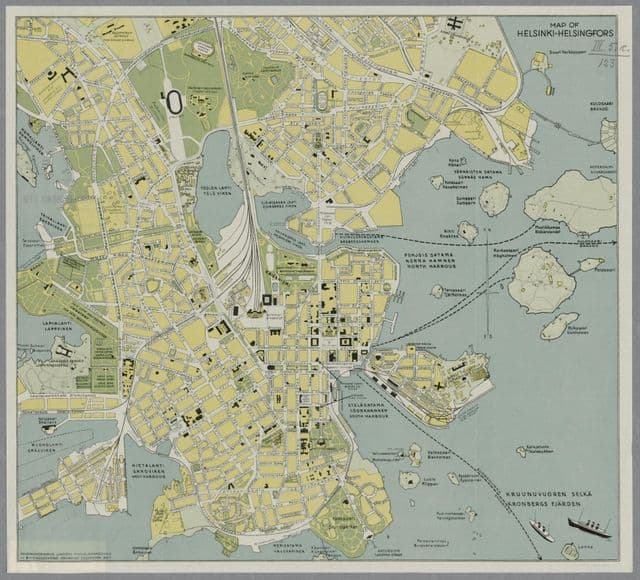
Helsinki historical map
The Helsinki old map shows evolutions of Helsinki city. This historical map of Helsinki will allow you to travel in the past and in the history of Helsinki in Uusimaa - Finland. The Helsinki ancient map is downloadable in PDF, printable and free.
In order to ensure the economic viability of the city, the King ordered the citizens of several other towns to relocate to Helsinki, but the order does not seem to have achieved its intended effect. The Swedish acquisition of northeastern Estonia , including Reval, at the conclusion of the Livonian War, caused the Swedish crown to lose interest in building up a competitor to Reval, and Helsingfors languished as a forgotten village for decades thereafter. In 1640, Helsinki was moved from its original location at the mouth of the historical river Vantaa (in Swedish: Vanda ), but the improved harbor failed to attract traders. It was fortified by the Swedish authorities, after Russia began to assert itself in the Baltic with the foundation of St. Petersburg, by Sveaborg / Viapori (today Suomenlinna ) to protect the city from Russian attacks as its shown in Helsinki historical map.
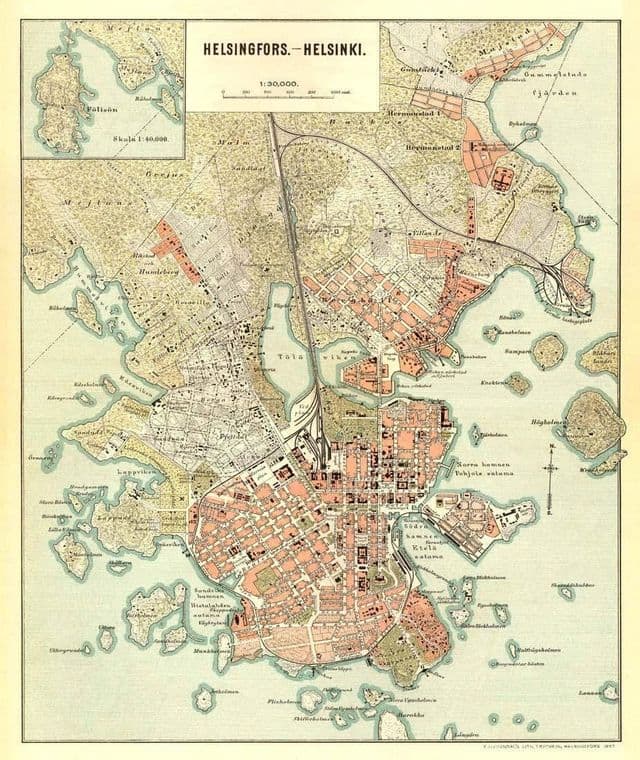
Helsinki vintage map
The Helsinki vintage map give a unique insight into the history and evolution of Helsinki city. This vintage map of Helsinki with its antique style will allow you to travel in the past of Helsinki in Uusimaa - Finland. The Helsinki vintage map is downloadable in PDF, printable and free.
In the 1918 Finnish Civil War, most of Helsinki fell to the Bolshevik-backed Red Guards along with the rest of southern Finland. The vintage Senate was relocated to Vaasa as you can see in Helsinki vintage map, although some senators and officials remained hiding in the capital. After the tide of the war turned against the Red forces, German troops, fighting on the same side with the Finnish White Guard, recaptured Helsinki in April. After the White victory, approximately 13,300 Red soldiers and collaborators were confined on the former naval fortress island of Suomenlinna in Helsinki. Although the civil war left a considerable mark on the society, the standard of living in the country and the city began to improve in the following decade. Renowned architects such as Eliel Saarinen created Utopian plans for Helsinki, but they were never fully implemented.